
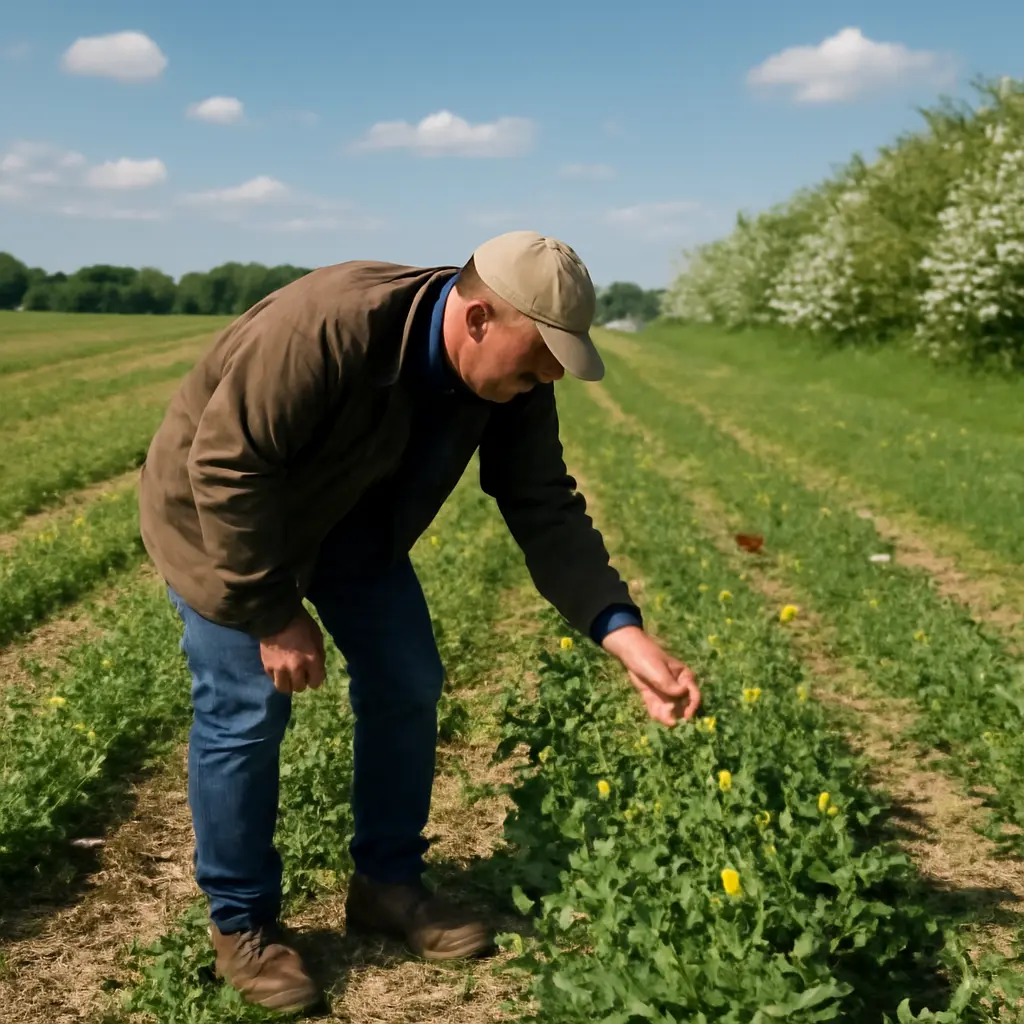
Pollinator-friendly farming means managing crops and field margins to provide flowers, nesting places, and shelter for bees, butterflies, hoverflies, and other pollinating animals. Farmers can support these species by combining crops or flowering cover plants with naturally vegetated field edges. The approach matters because more than three-quarters of the world’s leading food-crop types benefit to some degree from animal pollination, according to the Food and Agriculture Organization of the United Nations (FAO). Research also shows that pollinator responses depend on the surrounding landscape: diverse flowers and semi-natural habitat can complement one another, while pesticide exposure and simplified landscapes can undermine their benefits. This article explains how mixed plantings and natural edges work, what evidence supports them, and how farmers can put them into practice.
Pollinator habitat diversity and farm resilience
Pollinator habitat diversity is the variety and continuity of food, nesting, and shelter resources available across a farm and its surrounding landscape. The Intergovernmental Science-Policy Platform on Biodiversity and Ecosystem Services (IPBES) describes pollination as a regulating ecosystem service: animals transfer pollen between flowers, enabling the reproduction of many wild plants and contributing to crop production. In practical terms, a farm’s pollinator habitat includes flowering crops and cover crops as well as hedgerows, field margins, grass strips, and other semi-natural areas.
These components serve different but connected functions. A crop can provide a large, temporary pulse of flowers; a field edge can provide longer-lasting blooms, nesting sites, and shelter. Their value varies by region, crop, soil, climate, and management, so a single planting recipe does not fit every farm. The central principle is to provide complementary resources across the growing season while limiting hazards such as pesticide exposure.
Mixed plantings extend forage availability
Mixed plantings combine more than one crop, cover-crop species, or flowering plant in a field or rotation. They can increase the range of flower shapes, pollen and nectar sources, and bloom periods available to pollinators. For example, a cover-crop mix containing species that flower at different times may offer forage when the main crop is not in bloom. The benefit depends on plants actually flowering, being accessible to local pollinators, and not creating unacceptable competition with the cash crop.
A 2016 quantitative synthesis by Dainese and colleagues, published in Science, analyzed data from 89 studies across 1,475 locations. It found that landscape simplification and agricultural intensification were associated with reduced pollination and pest-control services, while biodiversity supported these services. The study does not establish that every mixed planting will increase yields; rather, it supports the broader case for maintaining biodiversity and evaluating farm practices in their landscape context.
Natural edges provide persistent habitat
Natural edges are uncropped or less intensively managed parts of a farm, such as hedgerows, grassy margins, flowering strips, and vegetated drainage boundaries. They can supply flowers between crop bloom periods and offer nesting or overwintering places. Their effectiveness depends on vegetation quality and maintenance: a narrow strip dominated by a few common plants may provide less varied forage than an edge with locally appropriate species flowering at different times.
Evidence from the United Kingdom illustrates why edges and crops should be considered together. In a 2013 study of 29 apple orchards, reported in Science, Garibaldi and colleagues found that wild-insect visitation was positively associated with both nearby semi-natural habitat and flower cover in the orchard. The research supports a complementary approach: retain habitat around fields while also managing flowering resources within the production area. It does not mean that the same habitat configuration will produce identical results for every crop or region.
Farm management practices that help pollinators
Farm practices determine whether plant diversity becomes useful habitat. A flowering strip has limited value if it blooms only briefly, is sprayed while pollinators are active, or lacks nesting resources for the species present. Planning should therefore link planting choices, bloom timing, field-edge care, and pest management. The following measures can be adapted to the farm’s crops, local conditions, and conservation objectives.
Choose plants for season-long bloom
A season-long planting plan uses several suitable species whose flowering periods overlap or follow one another, reducing gaps in forage. Farmers can select locally adapted native or non-invasive plants, alongside cover crops where appropriate, and prioritize a range of flower forms and bloom dates. Local extension services, conservation agencies, or seed specialists can help identify species suited to soil, climate, and target pollinators. Establishment success, water needs, and the risk of a plant becoming invasive should be considered before sowing.
Protect field edges and nesting places
Protecting edges means reducing unnecessary disturbance and maintaining a mix of flowering vegetation and suitable nesting habitat. Some wild bees nest in bare or sparsely vegetated ground; others use cavities, stems, or existing burrows. Leaving selected patches undisturbed, avoiding blanket mowing during peak bloom, and staggering mowing can preserve resources, provided these actions fit local weed-control and fire-safety requirements. Edge management should also prevent unwanted spread of invasive plants and avoid obstructing farm operations.
Reduce pesticide risks through integrated pest management
Integrated pest management (IPM) combines monitoring, prevention, biological controls, and carefully targeted pesticide use to manage pests while reducing risks to beneficial organisms. The U.S. Environmental Protection Agency advises following product labels and taking precautions to protect pollinators, including avoiding applications to blooming plants when bees are foraging and limiting drift onto flowering field margins. Farmers should follow current label requirements and local regulations, coordinate application timing with crop bloom and pollinator activity, and use the least disruptive effective option available.
Evidence, trade-offs, and farm-level evaluation
Pollinator-friendly practices can support biodiversity and pollination, but outcomes are not automatic. Weather, crop variety, surrounding habitat, pesticide exposure, and the availability of nesting sites all influence results. A useful evaluation tracks both ecological indicators and farm performance instead of assuming that more flowers alone guarantee higher yields.
What research says about pollination and production
The FAO reports that more than 75% of the world’s leading food-crop types benefit to some extent from animal pollination, including many fruits, vegetables, and nuts. That figure refers to crop types, not to the share of global food calories that would disappear without pollinators. IPBES has likewise emphasized pollinators’ contributions to crop production and wild-plant reproduction, while noting pressures such as land-use change, intensive agricultural practices, pesticides, pests, and climate change.
Field-level studies show why context matters. The Dainese synthesis linked biodiversity to pollination and pest-control services across many agricultural settings, and the Garibaldi orchard study found that both local flower cover and semi-natural habitat were associated with wild-insect visitation. These findings support diversified farm landscapes, but they are not a guarantee of a particular yield increase, nor do they mean that every crop depends equally on animal pollination.
Practical trade-offs and monitoring
Farmers may need to balance habitat goals with land availability, weed management, water use, machinery access, and production costs. Mixed plantings can require adjustments to planting schedules or termination dates, while field margins may compete for space or require establishment and maintenance. The best design is usually one that addresses a farm’s specific constraints and can be maintained over time.
A simple monitoring plan can compare treated areas with similar fields or margins managed under existing practices. Record plant establishment and flowering dates, observe pollinator visits using consistent routes and time periods, and track crop outcomes and management costs. Where possible, consult local conservation or extension specialists to identify appropriate indicators and avoid drawing conclusions from a single season, since pollinator activity varies with weather and yearly conditions.
Conclusion: diverse plantings and natural edges work together
Pollinator habitat diversity combines flowering resources within fields with persistent habitat along their edges. Mixed plantings can extend and diversify forage, while hedgerows, grassy margins, and other natural edges can provide additional flowers, shelter, and nesting opportunities. Research from broad agricultural analyses and orchard studies supports treating these elements as complementary, while also showing that outcomes depend on landscape and management conditions.
Farmers can start by mapping bloom gaps and existing habitat, selecting locally suitable plants, protecting useful edges, and reducing pesticide risks through IPM. Monitoring flowers, pollinator activity, crop performance, and costs can reveal which practices work on a particular farm. Further guidance is available from local agricultural extension services, conservation agencies, FAO, and IPBES.
Sources: Food and Agriculture Organization of the United Nations, Why Bees Matter: The Importance of Bees and Other Pollinators for Food and Agriculture, https://www.fao.org/3/i9527en/i9527en.pdf; Intergovernmental Science-Policy Platform on Biodiversity and Ecosystem Services, The Assessment Report on Pollinators, Pollination and Food Production, https://ipbes.net/assessment-reports/pollinators; Dainese, M. et al., “A global synthesis reveals biodiversity-mediated benefits for crop production,” Science, 2016, https://www.science.org/doi/10.1126/science.aaf1734; Garibaldi, L. A. et al., “Wild pollinators enhance fruit set of crops regardless of honey bee abundance,” Science, 2013, https://www.science.org/doi/10.1126/science.1230200; U.S. Environmental Protection Agency, Protecting Bees and Other Pollinators from Pesticides, https://www.epa.gov/pollinator-protection/protecting-bees-and-other-pollinators-pesticides.