
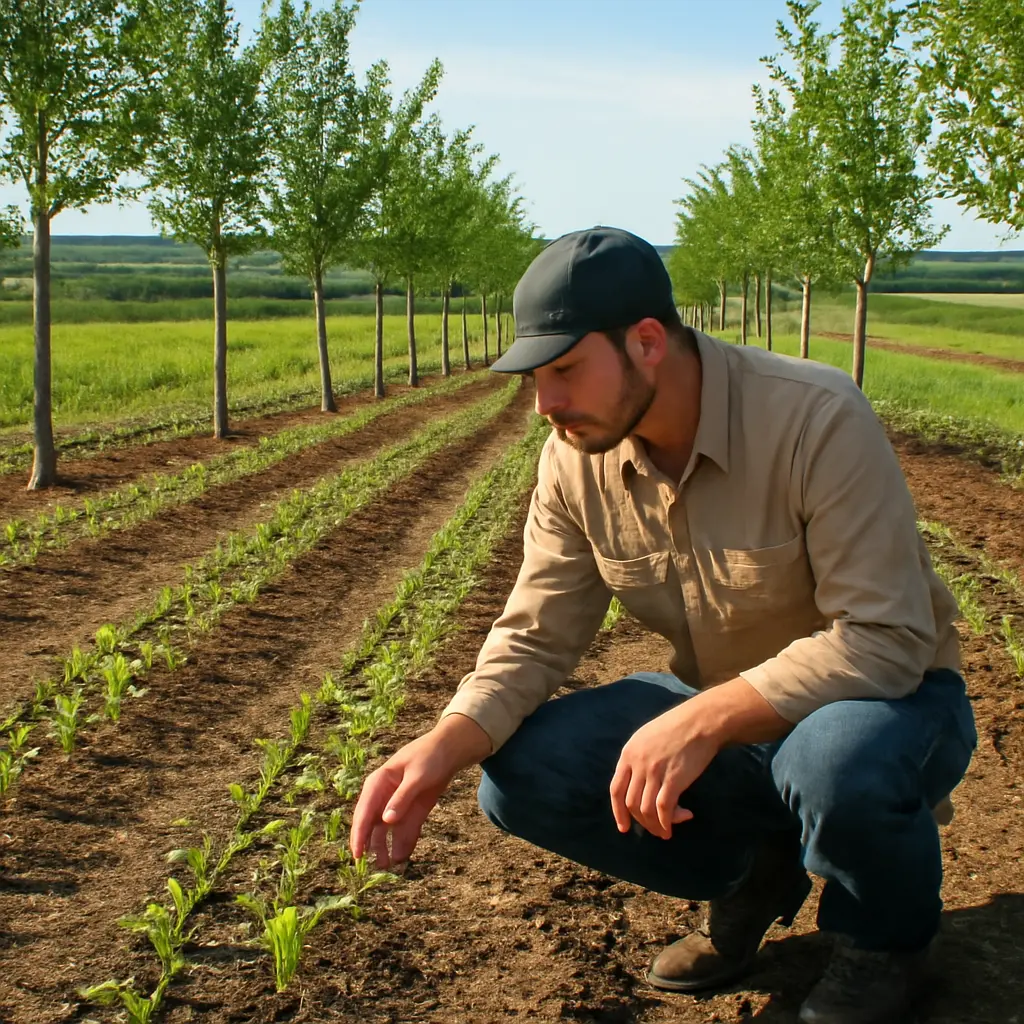
Agroforestry workshops teach farmers to integrate trees with crops or livestock while managing the practical trade-offs of land, labor, water, and markets. The strongest options combine classroom instruction with field demonstrations, planning, and follow-up: examples include World Agroforestry’s training, the Savanna Institute’s farmer education, the USDA National Agroforestry Center’s learning resources, and locally delivered programs from universities, conservation agencies, and farmer networks. Together, these seven workshop pathways help participants choose suitable tree-and-crop systems, establish them, and evaluate results. The need is substantial: the United Nations Environment Programme estimates that around two billion hectares of land worldwide are degraded, while the Food and Agriculture Organization reports that forests cover about 31 percent of global land area.
What Agroforestry Workshops Teach Farmers
Agroforestry is the intentional integration of trees and shrubs with crops, livestock, or both on the same land-management unit. The USDA National Agroforestry Center describes it as a set of practices that combines trees and agriculture to create environmental, economic, and social benefits. Unlike simply planting trees beside a field, agroforestry requires decisions about species, spacing, timing, management, and how trees interact with farm production.
The seven workshop options below are practical program types rather than a ranking of seven identical providers. Availability, costs, and curricula vary by location; farmers should confirm current dates and eligibility with the named organizations or local partners. For comparison, look for instruction that includes field practice, locally relevant species, a farm plan, and follow-up support—not just a one-day presentation.
1. World Agroforestry training and field learning
World Agroforestry, also known as the International Centre for Research in Agroforestry, develops training and knowledge resources on integrating trees into farms and landscapes. Its programs and partner-led learning opportunities address topics such as tree selection, farm diversification, soil improvement, restoration, and climate resilience. Farmers should check the organization’s current training calendar and regional partners because course availability and language differ by country.
A useful World Agroforestry-style workshop connects tree functions to farm decisions: a nitrogen-fixing tree may support soil fertility, while fruit or timber trees may provide products and income. Participants should leave with a species shortlist and a clear understanding of establishment and management requirements.
2. Savanna Institute farmer education and field days
The Savanna Institute works to advance agroforestry in the Midwest United States through research, demonstration, and farmer education. Its learning activities have included field days, workshops, and resources on systems such as alley cropping, silvopasture, and perennial crops. These events are especially relevant to farmers exploring tree crops or integrating livestock and trees in temperate climates.
Field-based instruction helps participants see how spacing, equipment access, vegetation management, and harvest logistics work in practice. Ask whether a specific event includes a farm walk, establishment costs, and discussion of market outlets; those details determine how easily a demonstration can transfer to a working farm.
3. USDA National Agroforestry Center learning and technical assistance
The USDA National Agroforestry Center provides technical information and supports agroforestry adoption in the United States. Its materials explain practices including alley cropping, forest farming, riparian forest buffers, silvopasture, and windbreaks. These are related approaches, but each addresses different goals and site conditions.
Farmers can use the center’s guides as workshop preparation or follow-up, then seek locally delivered assistance through conservation and extension partners. A well-designed session should connect a practice to the farm’s soils, slope, water, existing infrastructure, and production goals rather than treat a national guide as a one-size-fits-all prescription.
Choose Workshops by Agroforestry System
The most useful workshop depends on what the farmer wants trees to do. The USDA National Agroforestry Center’s five commonly recognized practices offer a practical way to sort training: some emphasize crops between tree rows, some integrate grazing, and others protect water or produce goods from woodland. The following workshop pathways focus on those distinct systems.
4. Alley-cropping workshops
Alley cropping grows agricultural crops in alleys between rows of trees or shrubs. Workshops typically cover row orientation, spacing, crop rotations, machinery access, tree-crop competition, and long-term changes as the canopy develops. The system can combine annual crops with timber, fruit, nuts, or other tree products, but its design must match the farm’s equipment and harvest plans.
A useful exercise is to map tree rows and turning areas over an existing field plan. Participants can compare the short-term crop area lost to tree rows with potential future products and conservation benefits. Workshop leaders should also discuss pruning and other management that can affect light and crop performance.
5. Silvopasture workshops
Silvopasture deliberately combines trees, forage, and livestock on the same land. Training should distinguish planned silvopasture from unmanaged wooded grazing and address animal movement, forage production, tree protection, shade, water access, and rotational grazing. The USDA National Agroforestry Center identifies silvopasture as one of the principal agroforestry practices in the United States.
The University of Missouri Center for Agroforestry has reported that shade can improve cattle comfort during heat stress, while actual benefits depend on climate, tree cover, animal management, and site design. A practical workshop therefore includes a pasture or woodland walk and a grazing plan, not only a discussion of tree planting.
6. Forest-farming workshops
Forest farming cultivates or manages marketable products under an existing forest canopy. Depending on region and regulations, products may include medicinal plants, mushrooms, fruits, nuts, or decorative greenery. Workshops should cover canopy and understory conditions, sustainable harvesting, product quality, food or herbal-product rules, and realistic market research.
This option can suit landowners who already have woodland and want to add value without converting it to open-field production. Training should be specific about the species and local ecology: a product that thrives in one region may be unsuitable or legally restricted in another. Participants should leave with a small-scale trial plan before investing in larger production.
7. Riparian-buffer and windbreak workshops
Riparian forest buffers place trees and other vegetation beside waterways, while windbreaks use rows of trees or shrubs to reduce wind exposure and protect fields, buildings, or livestock. Workshops on these practices commonly cover site assessment, species selection, planting layout, maintenance, and coordination with conservation programs. Their primary function may be protection rather than producing a harvestable crop, though suitable designs can provide products as well.
The USDA National Agroforestry Center identifies buffers and windbreaks as established agroforestry practices. The U.S. Department of Agriculture’s Natural Resources Conservation Service can provide conservation planning and may offer financial assistance through programs such as the Environmental Quality Incentives Program, subject to eligibility, funding, and local rules. Farmers should verify current program terms with their local NRCS office.
How to Judge a Tree-and-Crop Workshop
A workshop’s value depends on whether it helps a farmer move from general interest to a site-specific decision. Before registering, ask organizers about the instructor’s experience, the balance of classroom and field learning, and whether the course addresses local soils, climate, labor, and markets.
- Does the course cover more than one system, or clearly explain why it specializes in one?
- Will participants practice mapping a site, choosing species, or estimating spacing and establishment needs?
- Does instruction include tree protection, weed control, pruning, replacement planting, and maintenance after the first year?
- Are local buyers, processors, or experienced farmers included when a marketable product is part of the plan?
- Is follow-up available through extension, conservation staff, farmer networks, or a demonstration site?
The FAO’s global forest assessment reports that forests cover about 31 percent of the world’s land area, while UNEP estimates that roughly two billion hectares are degraded. These figures describe broad land and ecosystem challenges, not a guarantee that any particular agroforestry project will restore land or increase farm income. Local measurements and careful monitoring are essential.
Conclusion: Turn Workshop Learning into a Farm Plan
The seven workshop pathways—from World Agroforestry and Savanna Institute learning to USDA technical assistance, alley cropping, silvopasture, forest farming, and buffers or windbreaks—show that agroforestry is not a single recipe. Each system combines trees with crops or livestock for different production and conservation goals. The best training pairs credible instruction with field practice, local expertise, and a realistic plan for labor, management, and markets.
Farmers can begin by identifying one practical goal, such as diversifying income, protecting a stream, adding shade, or producing a perennial crop. Then contact a local extension office, conservation district, NRCS office, university agroforestry program, or farmer network to find current workshops and technical support. Start with a site assessment and small, measurable trial before scaling up.
Sources: World Agroforestry, Training and Capacity Development, https://www.worldagroforestry.org/; Savanna Institute, Farmer Education and Events, https://www.savannainstitute.org/; USDA National Agroforestry Center, Agroforestry Practices, https://www.fs.usda.gov/nac/practices/; University of Missouri Center for Agroforestry, Silvopasture, https://centerforagroforestry.org/; USDA Natural Resources Conservation Service, Environmental Quality Incentives Program, https://www.nrcs.usda.gov/programs-initiatives/eqip-environmental-quality-incentives; Food and Agriculture Organization of the United Nations, Global Forest Resources Assessment 2020, https://www.fao.org/forest-resources-assessment/2020/en/; United Nations Environment Programme, Land Restoration, https://www.unep.org/explore-topics/ecosystems-and-biodiversity/what-we-do/land-restoration