
Changing weather patterns are shifting the conditions farmers rely on to decide what to plant, when to plant it, and how to manage water, soil, pests, and harvests. Farm planning is the process of coordinating these choices across a season or longer; the U.S. Department of Agriculture (USDA) reports that the United States experienced 28 weather and climate disasters with losses exceeding $1 billion each in 2023. As seasons become less predictable, producers are using climate information, flexible planting windows, diversified crops, improved water management, and risk-protection tools to prepare for both gradual warming and damaging extremes.
Weather variability reshapes farm planning decisions
Farm planning means making linked decisions about land, crops, labor, equipment, inputs, water, storage, and finances in response to expected conditions. The USDA’s Climate Hubs describe climate adaptation as adjusting agricultural systems to reduce harm or take advantage of changing conditions. In practice, weather-aware planning connects long-term climate trends—such as warmer average temperatures—to short-term hazards, including heat waves, drought, heavy rainfall, and late frosts.
These risks are not uniform. The National Oceanic and Atmospheric Administration (NOAA) reports that the contiguous United States has warmed since the early 20th century, while precipitation patterns and extreme events vary by region. The Intergovernmental Panel on Climate Change (IPCC) finds that climate change has already affected agricultural productivity in many regions, with heat and drought among the pressures on crop and livestock systems. Local records and forecasts therefore matter: a strategy that helps a farm in a dry region may be unsuitable where intense rainfall and waterlogged soils are the greater concern.
Climate trends and operational weather
Climate describes long-term patterns, while weather refers to atmospheric conditions over shorter periods. Farm plans must account for both: climate trends inform investments and crop choices, while seasonal forecasts and short-range weather predictions guide planting, irrigation, spraying, and harvest timing. NOAA’s National Centers for Environmental Information provides historical climate data that farmers and advisers can use to compare local conditions across years.
Why extremes matter to farm budgets
Weather extremes can cause losses beyond reduced yields. Heavy rain may delay fieldwork, compact soil, increase erosion, or prevent machinery from entering fields; heat can raise livestock cooling needs and stress crops during flowering; drought can increase irrigation costs and competition for water. USDA’s disaster records show the scale of the wider risk: the 28 U.S. billion-dollar weather and climate disasters recorded in 2023 caused an estimated $92.9 billion in damages. These national figures do not predict losses on any individual farm, but they underscore why contingency plans and financial reserves are increasingly relevant.
Climate-informed crop and calendar planning
Climate-informed crop planning uses local observations, forecasts, and agronomic knowledge to match crops and field operations to changing growing conditions. It includes choosing varieties, adjusting planting dates, and deciding how much acreage to devote to each crop. Because each choice affects labor, machinery, input purchases, and market commitments, farmers increasingly evaluate options as connected scenarios rather than relying on a single expected season.
Planting windows and growing seasons
A planting window is the period when soil and weather conditions are suitable for establishing a crop. Warmer spring temperatures may allow earlier planting in some locations, but they do not eliminate risks such as frost, saturated fields, or a later cold snap. Farmers can compare historical frost dates, soil temperatures, short-range forecasts, and field drainage before moving planting dates. Flexible plans can include several feasible planting windows and identify which fields should be planted first based on soil type and access.
Crop and variety selection
Crop and variety selection determines how well a farm’s production system fits its expected heat, water availability, and growing-season length. Heat-tolerant or drought-tolerant varieties may reduce exposure to particular stresses, while earlier-maturing varieties can help avoid late-season hazards. The USDA’s National Agricultural Statistics Service reported that U.S. farmers planted 94.6 million acres of corn and 83.6 million acres of soybeans in 2024, illustrating how planting decisions operate at enormous scale. Those national totals are not a measure of climate adaptation by themselves; local soil, markets, seed availability, and crop rotations still shape the best choices for each farm.
Diversification and rotation
Diversification spreads production and market risk across crops, varieties, or farm enterprises. Crop rotations can also interrupt pest and disease cycles, distribute nutrient demands, and help maintain soil structure. A farmer might combine crops with different planting and harvest periods so that one weather event is less likely to damage every enterprise at once. Diversification is not a guarantee against losses: its effectiveness depends on local growing conditions, labor, equipment, storage, and access to buyers.
Water and soil management under shifting rainfall
Water and soil planning addresses two linked challenges: having enough water during dry periods and keeping fields productive during intense rainfall. NOAA’s National Climate Assessment documents changes in heavy precipitation and drought risks across parts of the United States. Because both can affect the same farm over a season, planning should consider drainage, water storage, irrigation capacity, soil cover, and erosion control together.
Irrigation and drought preparedness
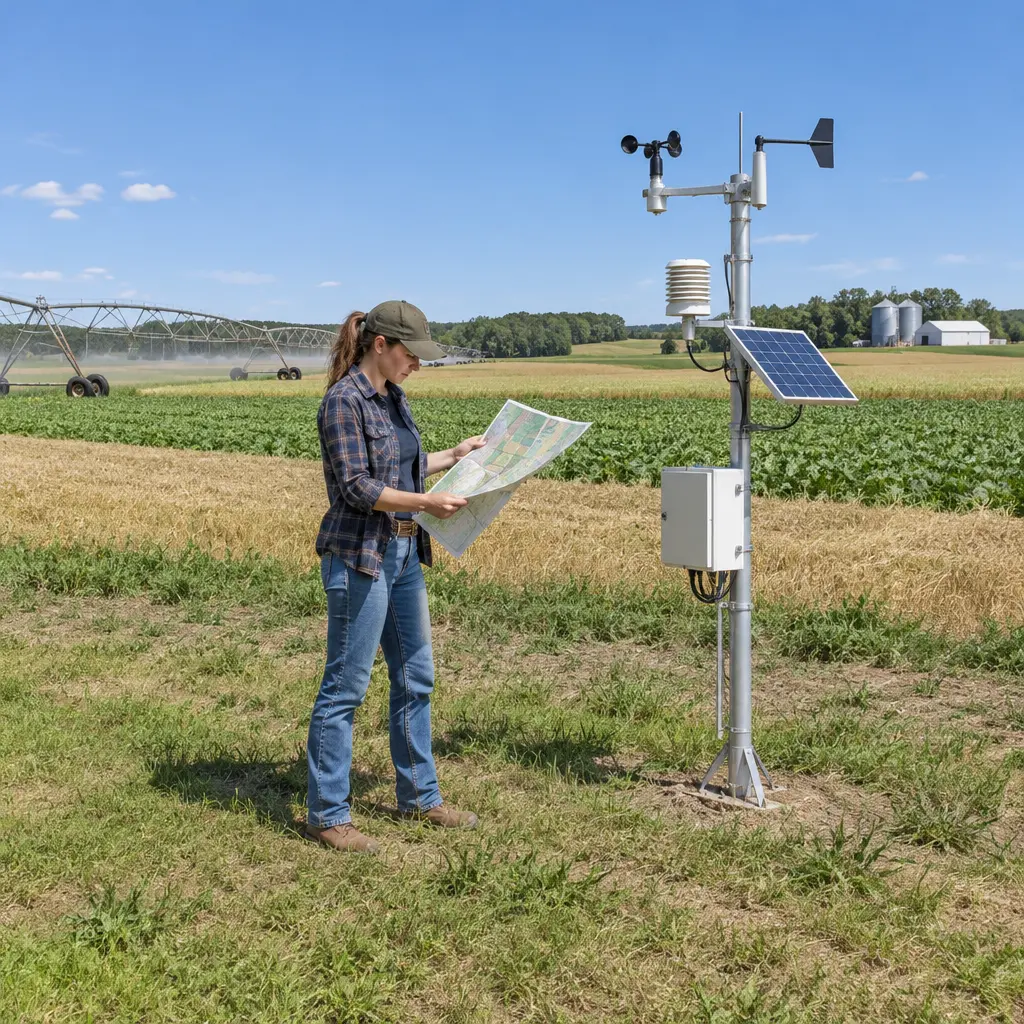
Irrigation planning determines when and how much water to apply, based on crop needs, soil moisture, weather, and available supplies. Soil-moisture sensors, weather stations, and irrigation scheduling can help avoid applying water when it is not needed. In water-limited regions, farmers may also prioritize irrigation for high-value or drought-sensitive crops and plan for restrictions or reduced allocations. The USDA Natural Resources Conservation Service (NRCS) supports conservation practices such as irrigation water management to improve the efficiency and timing of water use.
Drainage, erosion, and soil cover
Drainage and soil-cover measures help fields withstand heavy rainfall while protecting soil from erosion. Cover crops, reduced tillage, grassed waterways, and buffer strips can slow runoff and keep soil in place; drainage systems can help remove excess water where appropriate. NRCS identifies these and other conservation practices as tools for improving soil and water management. Selection should be based on field conditions and professional guidance, since drainage changes can affect downstream water flows and neighboring land.
Farm risk, infrastructure, and decision support
Weather-aware planning extends beyond crop production to the farm’s finances, buildings, equipment, and workforce. A resilient farm plan identifies which hazards could disrupt operations, estimates the consequences, and prepares alternatives. This links climate information to practical decisions such as when to buy inputs, where to store feed, how to protect animals, and what financial protection is available.
Forecasts, records, and scenario planning
Decision support combines weather forecasts with farm-specific records, including planting dates, yields, soil conditions, and input costs. NOAA seasonal outlooks can help users assess broad temperature and precipitation tendencies, but they do not provide certainty about conditions on a particular field or day. Farmers can use several scenarios—such as a wet spring, a hot summer, or delayed harvest—to set triggers for actions, including switching fields, adjusting irrigation, or arranging custom machinery. Historical farm records help test whether those choices are practical.
Insurance, emergency plans, and infrastructure
Risk protection combines financial tools with operational preparations. USDA’s Risk Management Agency administers federal crop insurance programs that can help eligible producers manage certain production and revenue losses, subject to policy terms and deadlines. Farms can also prepare backup power, secure fuel and feed, protect livestock from heat or floods, and identify alternate routes and storage locations. Reviewing coverage and emergency procedures before a hazard occurs is more useful than relying on last-minute decisions during a disaster.
A practical example: adapting a planting plan
Consider a farm facing both increasingly wet spring conditions and summer dry spells. Rather than planting every field on the same schedule, the producer could prioritize well-drained fields for early planting, reserve wetter fields for later windows, and use soil-moisture information to guide irrigation. Cover crops and improved field drainage may reduce erosion or waterlogging risks, while crop diversification can limit dependence on a single harvest. This is an illustrative planning approach, not a universal prescription: local forecasts, conservation advice, crop markets, and farm-specific economics should determine which measures are suitable.
Conclusion: planning for uncertainty
Changing weather patterns are reshaping farm planning by making crop calendars, variety choices, water and soil management, infrastructure, and financial protection more interdependent. Climate-informed planning does not mean predicting every event; it means using local data, farm records, and credible forecasts to prepare workable alternatives. Farmers can start by reviewing their exposure to heat, drought, flooding, and seasonal delays, then discuss adaptation options with local extension services, conservation specialists, and insurance providers. Continued investment in climate information and practical farm-level research will be essential to sustaining agricultural productivity and rural communities.
Sources: U.S. Department of Agriculture, USDA Climate Hubs, https://www.climatehubs.usda.gov/; National Oceanic and Atmospheric Administration, National Centers for Environmental Information, U.S. Billion-Dollar Weather and Climate Disasters, https://www.ncei.noaa.gov/access/billions/; Intergovernmental Panel on Climate Change, Climate Change 2022: Impacts, Adaptation and Vulnerability, https://www.ipcc.ch/report/ar6/wg2/; National Oceanic and Atmospheric Administration, Fifth National Climate Assessment, https://nca2023.globalchange.gov/; U.S. Department of Agriculture, National Agricultural Statistics Service, Acreage, June 2024, https://www.nass.usda.gov/Publications/Todays_Reports/reports/acrg0624.pdf; U.S. Department of Agriculture, Natural Resources Conservation Service, Conservation Practices, https://www.nrcs.usda.gov/conservation-basics/conservation-by-state; U.S. Department of Agriculture, Risk Management Agency, https://www.rma.usda.gov/