
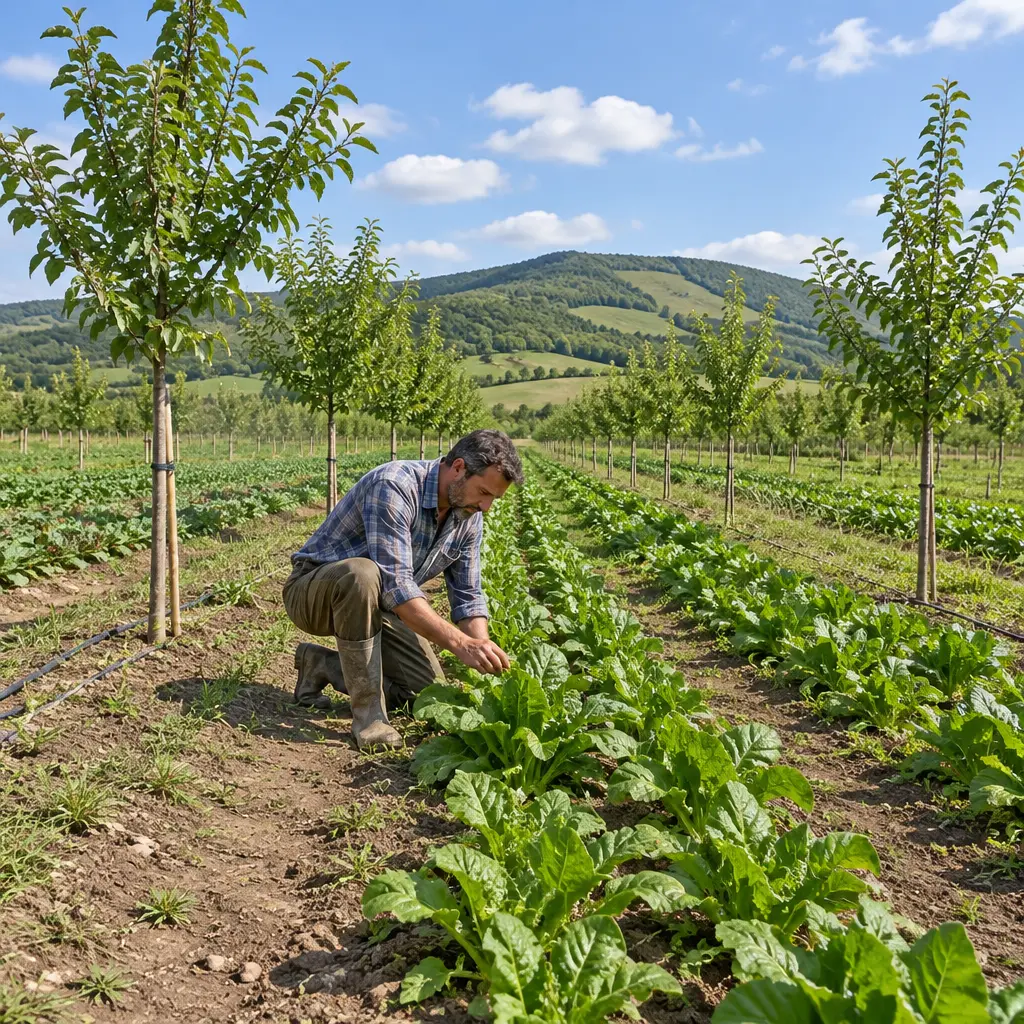
Agroforestry integrates trees and shrubs with crops, livestock, or both on the same land, combining ecological processes with food production. The Food and Agriculture Organization of the United Nations (FAO) describes it as a land-use system that deliberately combines woody perennials with agricultural crops and/or animals. By adding trees to farms, agroforestry can diversify harvests, protect soil and water, provide habitat, and help farmers manage climate and market risks. Its results depend on the species, design, and local conditions: trees may improve some farming outcomes, but benefits are not automatic and can take years to develop.
How Agroforestry Combines Ecology and Food Production
Agroforestry is relevant because agriculture faces the linked challenges of producing food, sustaining soils, conserving biodiversity, and adapting to climate change. The World Resources Institute’s 2019 synthesis estimated that agroforestry could contribute to climate mitigation at scale, while the FAO has reported that agricultural expansion is a major driver of deforestation. These broad findings do not mean every tree-based farm delivers the same environmental or yield gains. They do show why agroforestry is studied as a way to make working landscapes serve several purposes at once.
Agroforestry Systems Connect Ecological Processes with Farm Production
Agroforestry systems are intentionally designed arrangements in which trees or shrubs interact with crops, livestock, or both. The USDA National Agroforestry Center defines agroforestry as the intentional integration of trees and shrubs into crop and animal farming systems to create environmental, economic, and social benefits. This definition distinguishes agroforestry from simply having trees near a farm: the woody plants are planned as part of production and land management.
Common system types include silvopasture, alley cropping, forest farming, windbreaks, and riparian forest buffers. Their shared ecological logic is to use complementary layers and functions: trees can provide shade, roots can stabilize soil, flowers and understory plants can support pollinators, and farm products can come from multiple species. The degree of benefit depends on tree choice, spacing, water availability, management, and the needs of the main crop or livestock.
Silvopasture Integrates Trees, Forage, and Livestock
Silvopasture is the planned management of trees, forage, and grazing animals together. Trees may provide shade and shelter, while forage supplies feed and animals contribute products such as meat or milk. The USDA National Agroforestry Center identifies silvopasture as one of the five recognized agroforestry practices in the United States. Successful designs balance tree density with sunlight and forage growth, protect young trees from livestock damage, and prevent overgrazing.
Shade can help livestock cope with heat, but outcomes vary with climate, species, and pasture design. A system also needs suitable water access and a grazing plan so that animals do not compact wet soils or strip vegetation. Silvopasture therefore combines animal welfare and farm diversification with active ecological management rather than treating trees as a passive addition.
Alley Cropping Uses Space Between Rows of Trees
Alley cropping grows annual crops or forage in alleys between rows of trees or shrubs. Farmers may harvest grain, vegetables, or forage while the woody rows produce nuts, fruit, timber, or other products. The USDA National Agroforestry Center notes that the spacing and orientation of tree rows should account for sunlight, machinery, soil, and the mature size of the trees.
This layout can diversify farm income and reduce wind exposure, while tree roots and leaf litter may contribute to soil protection and organic matter. Competition for water, nutrients, and light can also reduce crop performance if rows are poorly placed or unmanaged. Pruning, species selection, and crop rotations help determine whether the system’s combined outputs justify its labor and establishment costs.
Forest Farming Produces Goods Under a Canopy
Forest farming is the cultivation or management of marketable products beneath an existing or established tree canopy. Products may include edible or medicinal plants, mushrooms, and specialty materials, depending on local ecology and regulations. Unlike clearing woodland for open-field crops, forest farming retains a managed canopy and uses its sheltered understory for production.
The practice can make existing woodland more productive while maintaining tree cover, but it requires knowledge of shade levels, species identification, harvest limits, and market demand. The USDA National Agroforestry Center includes forest farming among its five core practices, underscoring that agroforestry can operate in both farm fields and wooded landscapes.
Windbreaks and Riparian Buffers Protect Farm Landscapes
Windbreaks are rows of trees or shrubs designed to reduce wind speed across fields, farmsteads, or livestock areas. Riparian forest buffers are vegetated zones beside streams and other water bodies. Both are agroforestry practices, although their primary benefits may be protective rather than food-producing: they can reduce wind erosion, intercept runoff, and provide habitat while farms continue producing nearby.
The USDA National Agroforestry Center identifies windbreaks and riparian buffers as two of its five main practices. Buffer performance depends on width, vegetation, slope, soil, and the pollutants being managed. These systems illustrate how agroforestry connects production with landscape-scale services: a tree row or streamside planting can support farm resilience without replacing the surrounding agricultural use.
Agroforestry Improves Food-System Resilience Through Ecological Functions
Agroforestry’s ecological functions can support production by influencing soil, water, biodiversity, and microclimate. The relationship is not one-way: farm management shapes the habitat that trees create, and ecological changes can affect farm yields and labor. Evidence from the Intergovernmental Panel on Climate Change and FAO emphasizes that adaptation and sustainability are context-specific, making local assessment essential.
Soil Cover and Root Systems Help Limit Degradation
Trees can protect soil through canopy cover, leaf litter, and root networks that hold soil in place. Deep-rooted woody plants may access nutrients and water from soil layers that shallow-rooted crops use less intensively, though competition can occur. The FAO’s Global Soil Partnership identifies erosion, declining soil organic carbon, and nutrient imbalance among major soil threats worldwide, giving soil-protective practices a significant role in sustainable agriculture.
In agroforestry, fallen leaves and pruned material can add organic matter, while tree roots may improve soil structure. These processes develop over time and depend on species and management. Farmers should monitor crop performance and soil conditions rather than assume that tree cover alone guarantees improved fertility.
Water Management Links Farms to Watershed Health
Agroforestry can influence how rainfall moves across a farm. Vegetation slows surface flow, roots create pathways through soil, and riparian buffers can trap sediment before it reaches streams. The U.S. Environmental Protection Agency identifies agricultural runoff as a source of nutrients and sediment that can impair water quality. Vegetated buffers are one tool for reducing that movement, alongside nutrient planning and other conservation measures.
Trees also use water, so their placement matters in dry regions or where crops already face water stress. A well-designed system matches species and density to local rainfall, soils, and water availability. The goal is not simply to maximize tree cover, but to balance water retention, crop needs, and watershed protection.
Habitat and Pollination Can Support Production
Tree rows, flowering shrubs, and diverse understories can create habitat and food resources for pollinators, birds, and beneficial insects. The FAO’s assessment of pollinators notes that a substantial share of crop types depends at least partly on animal pollination. Agroforestry can contribute habitat within agricultural landscapes, although the effect on a particular crop depends on pollinator species, flowering periods, pesticide practices, and landscape context.
Biodiversity also has value beyond direct yield effects, including supporting ecological functions and conserving native species. Planting locally appropriate trees and maintaining habitat connections can strengthen these benefits. Conversely, invasive species or poorly managed monoculture tree rows may provide fewer ecological advantages than diverse, well-sited plantings.
Microclimates and Climate Adaptation Reduce Some Risks
Trees alter local conditions by providing shade and reducing wind exposure. These microclimate effects can protect livestock and some crops from heat or wind stress, but shade may also limit light for sun-loving crops. The IPCC’s Sixth Assessment Report describes agroforestry among land-based adaptation options, while stressing that effectiveness depends on local circumstances and that adaptation measures can involve trade-offs.
The World Resources Institute’s 2019 report, “The Global Tree Restoration Potential,” estimated that agroforestry on existing agricultural land could provide a climate mitigation opportunity of about 3.4 gigatons of carbon dioxide equivalent per year by 2050 under its modeled scenarios. This is a global potential estimate, not a guaranteed outcome for individual farms; actual carbon storage depends on land eligibility, tree survival, management, and accounting assumptions.
Agroforestry Diversifies Food and Farm Income
Agroforestry can combine food production with products such as fruit, nuts, timber, fodder, and specialty crops. Multiple outputs may spread risk across seasons and markets, but they can also require new skills, equipment, processing, and buyers. The FAO’s work on sustainable food systems highlights diversification as one pathway toward resilience, while farm-level profitability remains dependent on costs, prices, and the time required for trees to mature.
Product Diversity Can Spread Market and Weather Risk
A diversified agroforestry farm may harvest annual crops in the short term and tree products over longer cycles. If one product performs poorly, another may provide partial income or household food. This is a risk-management possibility, not a certainty: products can be exposed to correlated hazards, and new markets may be unreliable or distant.
Planning should therefore include a realistic assessment of labor, storage, processing, transport, and market access. Farmers may also need to consider land tenure and the length of time before trees generate returns. Extension services, producer cooperatives, and locally adapted finance can help bridge the establishment period.
Food Security Benefits Depend on Local Design
Agroforestry can contribute food directly through fruits, nuts, leaves, and other edible products, while also supporting livestock feed and farm income. The FAO has documented the role of trees in agricultural landscapes as sources of food, nutrition, and livelihoods. The food-security contribution varies widely: species must suit local diets and growing conditions, and households need access to harvests and markets.
A well-designed system can complement staple crops rather than displace them. Farmers and communities should consider seasonal food gaps, cultural preferences, land rights, and who controls tree products. These social and economic factors are as important as ecological performance when evaluating whether an agroforestry project improves food security.
Agroforestry Case Studies Show How Design Shapes Outcomes
Real-world agroforestry ranges from managed forest gardens to tree-crop-livestock systems and streamside buffers. Comparing examples helps show why there is no universal layout: climate, species, land use, and local knowledge determine which ecological functions can coexist with production.
Sahel Farmer-Managed Natural Regeneration
In parts of the Sahel, farmer-managed natural regeneration (FMNR) protects and manages trees and shrubs that regrow from living stumps, roots, or seeds in cultivated fields. The World Agroforestry (CIFOR-ICRAF) and development organizations have documented FMNR as a low-cost approach used by farmers to restore tree cover while continuing crop production. Farmers select and prune regrowth, integrating woody plants into existing fields rather than establishing every tree through planting.
The approach can provide fuelwood, fodder, shade, and other products while helping protect soil, but results vary with rainfall, species, tenure, and farmer incentives. Its practical lesson is that agroforestry may build on naturally regenerating vegetation and local knowledge, not only on purchased seedlings or formal plantations.
Cocoa Agroforestry in Tropical Landscapes
Cocoa agroforestry grows cocoa beneath a managed canopy of shade trees, often alongside fruit or timber species. Research synthesized by the World Agroforestry (CIFOR-ICRAF) has examined how shade management affects biodiversity, microclimate, and cocoa production. Shade can provide habitat and buffer heat, but excessive or poorly managed shade may increase disease pressure or reduce cocoa yields in some settings.
The example demonstrates the importance of balancing ecological goals with crop-specific requirements. Farmers need locally suitable shade levels, disease management, and reliable markets for additional products. Certification or sustainability programs may encourage tree retention, but their effectiveness depends on implementation and farmer benefits.
Agroforestry Success Requires Planning, Evidence, and Support
Because trees are long-lived investments, agroforestry decisions should begin with site conditions and farmer objectives. The USDA National Agroforestry Center and FAO resources emphasize matching practices to local ecological and production needs. A farm may use one practice or combine several, but monitoring is essential to identify trade-offs and adjust management.
- Identify the main goals, such as erosion control, livestock shade, food diversity, or stream protection.
- Assess soil, rainfall, water availability, slope, existing vegetation, and machinery access.
- Select tree and crop species suited to local conditions, markets, and community preferences.
- Plan spacing, pruning, grazing, and protection of young trees, including labor and establishment costs.
- Track production, tree survival, soil and water indicators, biodiversity, and household or farm income over time.
Public policy and technical assistance also matter. Farmers may need secure tenure, access to seedlings, extension advice, long-term financing, and markets for tree products. Since benefits can take years to appear, programs that reward only short-term outputs may discourage adoption. Evaluation should include both farm-level outcomes and wider effects on soil, water, biodiversity, and carbon.
Conclusion: Agroforestry Makes Working Landscapes Multifunctional
Agroforestry combines ecological processes and food production by integrating trees and shrubs with crops, livestock, or both. Silvopasture, alley cropping, forest farming, windbreaks, and riparian buffers demonstrate the range of ways this can be done. Tree-based systems may protect soil and water, support habitat, moderate microclimates, and diversify food and income, while outcomes depend on species, design, time, and local management.
The broader implication is that farms can contribute to both production and landscape health when ecological functions are designed into land use. Farmers, planners, and communities can take a practical next step by assessing local goals, consulting agroforestry extension resources, and testing suitable designs with measurable indicators. Further reading from the USDA National Agroforestry Center, FAO, and World Agroforestry can help translate general principles into locally appropriate plans.
Sources: Food and Agriculture Organization of the United Nations, Agroforestry, https://www.fao.org/forestry/agroforestry/en/; USDA National Agroforestry Center, What Is Agroforestry?, https://www.fs.usda.gov/nac/practices/; World Resources Institute, The Global Tree Restoration Potential, 2019, https://www.wri.org/research/global-tree-restoration-potential; Intergovernmental Panel on Climate Change, Climate Change 2022: Impacts, Adaptation and Vulnerability, https://www.ipcc.ch/report/ar6/wg2/; Food and Agriculture Organization of the United Nations, Global Soil Partnership, https://www.fao.org/global-soil-partnership/en/; U.S. Environmental Protection Agency, Nonpoint Source: Agriculture, https://www.epa.gov/nps/nonpoint-source-agriculture; Food and Agriculture Organization of the United Nations, The Assessment Report on Pollinators, Pollination and Food Production, https://www.fao.org/3/i8816en/I8816EN.pdf; World Agroforestry (CIFOR-ICRAF), Farmer Managed Natural Regeneration, https://www.worldagroforestry.org/; World Agroforestry (CIFOR-ICRAF), Cocoa Agroforestry, https://www.worldagroforestry.org/.